
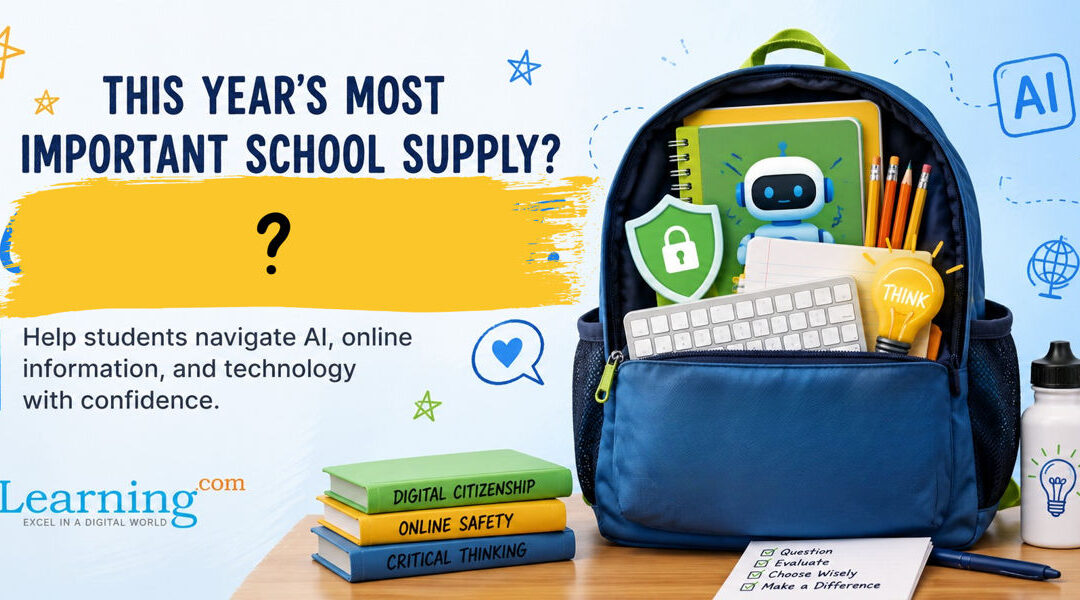
Every year, families work their way through the familiar back-to-school list: pencils, notebooks, folders, backpacks, maybe a new device or a pair of headphones.
But there’s another school supply students need more than ever, and you won’t find it in the back-to-school aisle.
Good judgment.
Think about all the tiny decisions a child makes.
- A first grader decides whether something another child said was kind.
- A third grader decides whether to tell someone something a friend asked them to keep secret.
- A fifth grader decides whether a video that looks convincing is actually true.
- A middle schooler decides whether to forward a screenshot.
- A student sees an AI-generated answer that sounds authoritative and decides whether to trust it.
- Someone online asks for information and the child has to decide: Is this okay to share?
On the surface, these decisions may seem unrelated. Some happen in the classroom. Some happen between friends. Some happen online. And some involve technologies that didn’t exist when today’s parents and educators were growing up.
But underneath them is the same skill: judgment.
We spend a lot of time thinking about what children need to know. We teach facts, skills, procedures, and rules. We put important guardrails in place to protect them.
But eventually, every child encounters a situation for which we haven’t given them a rule.
That’s when judgment matters.
And good judgment doesn’t suddenly appear at 16 or 18. It develops over time, through hundreds of small opportunities to pause, question, weigh consequences, make a choice—and sometimes realize that the choice we made wasn’t the best one.
And because good judgment takes practice, we have two free resources to share that can help bring these ideas into the classroom. We’ll share them with you below.
Judgment is built one small decision at a time
When we talk about preparing students for a digital world, it’s tempting to focus on rules.
Don’t share your password! Don’t talk to strangers online! Check your source! Think before you post! Don’t automatically trust an AI-generated answer!
Those rules matter. But rules can only take students so far.
The world our children are entering will present them with situations we haven’t anticipated, technologies we haven’t seen and choices for which we couldn’t possibly have written the rules in advance.
We can’t prepare children for every decision they will encounter. We can prepare them to make decisions.
That requires more than telling students what to do. They need opportunities to practice figuring out what to do—and why.
Sometimes the best teaching starts with a question
- A child asks, “Is this website true?”
- Our instinct may be to answer.
- But what if, sometimes, we answered with another question?
- What makes you think it is?
- A child asks, “Can I post this picture?”
- Who do you think will be able to see it?
- AI gives a student an answer that doesn’t quite sound right.
- How could you check?
- A child is upset about something a friend wrote online.
- What do you think might happen if you respond right now?
These are small moments. But every time we return some of the thinking to the child, we create an opportunity to practice judgment.
And those opportunities aren’t limited to technology.
Children practice judgment when they resolve a disagreement with a friend, decide whether something is fair, determine which information they need to solve a problem or think through how a choice might affect someone else.
As adults, we can make space for that thinking with questions like:
- What do you think?
- What makes you believe that?
- What information are you missing?
- Who might be affected by that choice?
- What could happen next?
- What might you do differently?
Good judgment grows through practice. And that includes opportunities to make mistakes, reflect and try again.
Guardrails matter. But so does what happens without them.
There is a tension every parent and educator understands: We want children to become independent, but we also want to protect them.
Technology can make that instinct even stronger.
We can block websites. Restrict apps. Filter content. Set privacy controls. Establish rules about devices and AI. And depending on a child’s age, many of those guardrails are entirely appropriate.
But guardrails and judgment serve different purposes.
Guardrails help protect children while they are learning. Judgment helps prepare them for the day when the guardrails aren’t there.
That means students need age-appropriate opportunities to make decisions, explain their reasoning, experience consequences and reconsider their choices.
The goal isn’t to remove every bad choice from a child’s path. It’s to help them develop the thinking they’ll need when we’re no longer standing beside them.
What good judgment looks like changes as children grow
We wouldn’t ask a kindergartner to wrestle with the same decisions as an eighth grader.
Judgment develops progressively.
For younger students, it can begin with something as simple as learning to stop before sending a message and consider: How might the other person feel when they read this?
As children get older, the questions become more complex.
- What information about me is okay to share?
- What should stay private?
- Who can see something after I post it?
- How do I know whether the information I’m seeing is credible?
Later, students can grapple with identity, security, misinformation, digital footprints and the consequences of choices that can travel far beyond their original audience.
AI introduces another layer.
Students aren’t only consuming information anymore. They can ask a tool to generate an answer, an image, a story, a presentation or code in seconds.
So the questions evolve again.
- Is this accurate?
- Where did this information come from?
- Could there be bias in this answer?
- What should I verify?
- Is using AI appropriate for what I’m trying to accomplish?
- What part of this work should come from me?
- Can AI help me create or solve something I couldn’t have before?
Across all of these situations, the specific decision changes, but the habit we’re trying to build is remarkably consistent:
Stop. Think. Choose.
- Stop before reacting, clicking, sharing or automatically accepting an answer.
- Think about what you know, what you don’t know, who might be affected and whether you need more information.
- Choose what to do next.
It’s a simple framework, but that’s precisely the point. Children need ways of approaching decisions that they can carry from one situation to another—and eventually use without an adult prompting them.
Bring Stop. Think. Choose. into your classroom
Help students practice the habit of pausing, thinking and making thoughtful choices with our free, age-appropriate classroom posters:
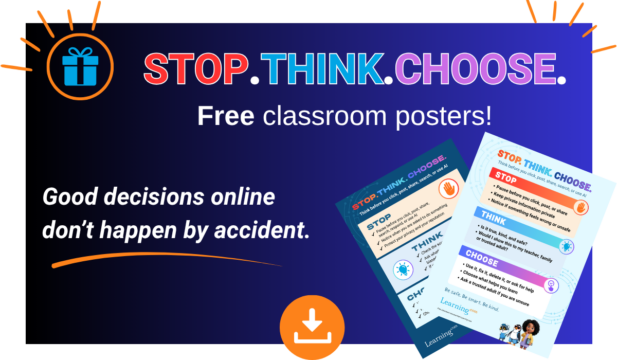
Download the K–5 Stop. Think. Choose. poster
Download the Grades 6–8 Stop. Think. Choose. poster
As AI becomes more capable, the ability to exercise human judgment becomes more important, not less.
The digital world gives us opportunities to practice
At Learning.com, we see digital learning as one of the places where students can deliberately practice these habits of mind.
Students can learn that their words and actions affect other people online. They can practice deciding what information is appropriate to share and what should remain private. As they grow, they can encounter increasingly complex questions about identity, security, credibility, misinformation and the consequences of their digital choices.
And increasingly, those conversations include AI.
Students need age-appropriate opportunities not just to learn about artificial intelligence, but to practice what it means to use it thoughtfully—to question what it produces, evaluate its output, recognize its limitations, and use it to explore, solve problems and create.
At Learning.com, Stop. Think. Choose. is part of how we approach AI literacy, but the habit itself reaches much further. Whether students are deciding what information to share, evaluating whether a source is credible, considering how their actions affect others or questioning an AI-generated response, the goal isn’t simply to know the rule.
It’s to learn how to make a thoughtful choice.
These may be digital literacy, online safety, digital citizenship and AI literacy skills.
But together, they are something larger.
They are practice in making good decisions.
Preparing students for decisions we can’t predict
- We don’t know what technology today’s first graders will be using when they graduate from high school.
- We don’t know what AI will be capable of by then.
- We don’t know which platforms will exist, how students will communicate or what new challenges will emerge.
And that may be exactly why judgment matters so much.
Preparing students for every tool they will encounter is impossible. Preparing them to think carefully about the tools, information and choices they encounter is not.
We can teach them to stop before reacting. To think before automatically believing or sharing. And to choose what to do next based on what they know, what they don’t know and what the consequences might be.
We can help them distinguish public from private. Recognize what they don’t know. Seek help when they need it. And use technology not simply because they can, but because they’ve thought about whether they should—and what they hope to accomplish with it.
We can also give them opportunities to get it wrong sometimes, while adults are still nearby to help them think about what happened and what they might do differently next time.
Because ultimately, we don’t build judgment by giving children the answer to every question.
We build it by helping them learn how to decide when the answer isn’t obvious.
That may be one of the most important things we can send students back to school with this year.
And unlike most school supplies, it’s something they can carry with them long after the backpack is gone.
Help your students start the year with good judgment.
What’s next?
If you would like to give your child or student(s) a basic start to digital and AI literacy and/or see what it looks like for yourself, you can access our free Digital Literacy and AI Kit. It is a curated set of lessons from Learning.com’s Digital and AI Literacy curriculum for K-8 students. There is one form to fill out for access but after that, no need to enter any student information. CLICK HERE TO START WITH THE FREE KIT