
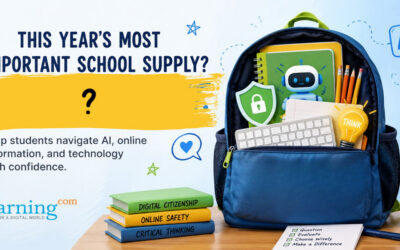
The Most Important School Supply Isn’t on the List
Every year, families work their way through the familiar back-to-school list: pencils, notebooks, folders, backpacks, maybe a new device or a pair of headphones.
But there’s another school supply students need more than ever, and...

AI literacy has to be about more than AI
I recently went to Google and searched for the most common definitions of AI literacy. After skipping the AI-generated response, I found definitions that generally sounded like this:
- The ability to recognize, understand, use,...
AI for K–2? Yes!
Why AI Safety Starts in K–2
AI is already part of students' daily lives, even in the earliest grades.
Young learners are interacting with voice assistants, recommendation systems, and AI-powered tools at home and in...

State of K–8 Digital + AI Literacy: What’s Changed – and What Schools Need to Do Next
AI didn’t create the need for digital literacy, but it did expose how urgent it has become.
Students are using AI tools to search, write, solve, create, and often without understanding how those tools work...
K–8 AI Safety & Guardrails: What Schools Must Get Right Now
Students aren't waiting to be taught AI - they're already using it.
What they're missing isn't access. It's guidance.
As districts move from "Should we allow AI?" to "How do we ensure teachers and students...
It Is Not About the Tool. It Is About the Thinking.
In honor of AI Literacy Day, we wanted to offer a practical way to explore what AI literacy really means for students and for schools.
Rather than starting with tools or policies, we started with...