
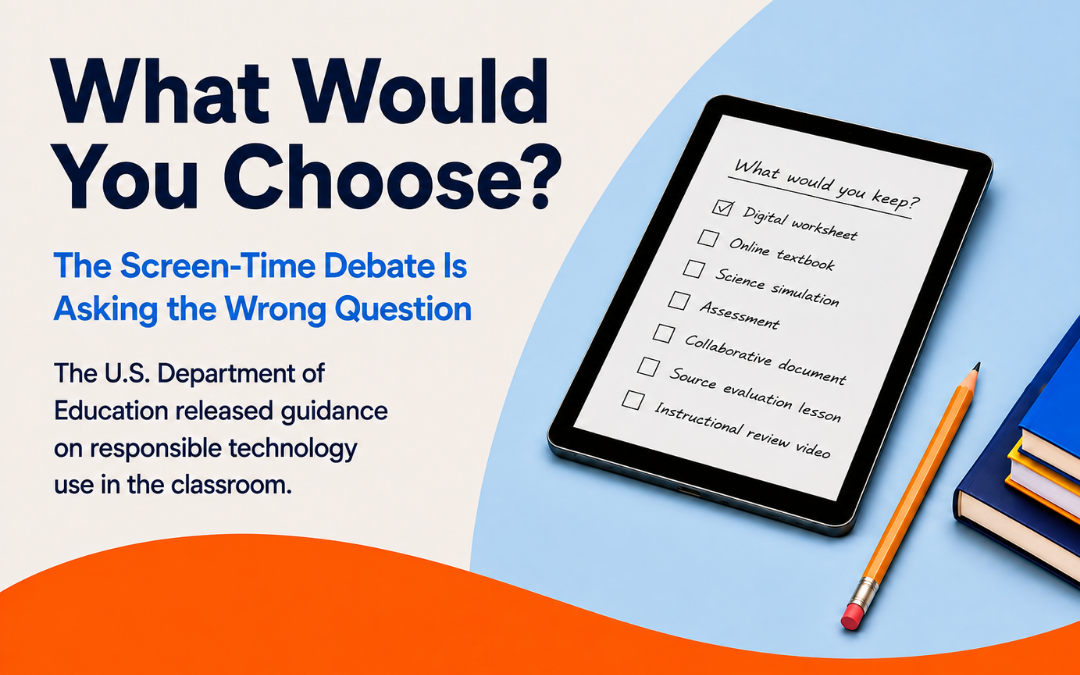
The Screen-Time Debate Is Asking the Wrong Question
Have we put too much learning on screens? And if we have, what would you keep and what would you cut?
In August 2026, something happened that made the question about responsible technology use in schools harder to ignore.
The U.S. Department of Education released new guidance on the responsible use of education technology in classrooms. One part in particular caught our attention: the Department called on education technology providers to “minimize unnecessary screen time” and encouraged schools to examine not just how much time students spend on screens, but whether that time contributes to meaningful learning outcomes.
For an education technology company, there is an obvious answer we are probably expected to give. No. Educational screen time is different. It’s purposeful. It’s learning.
But we don’t think that’s good enough.
Over the last decade, schools moved enormous parts of the school day onto screens. Some of it transformed what students and educators could do.
Some of it just turned paper into pixels.
That got us thinking.
What exactly is unnecessary instructional screen time?
- A digital worksheet?
- An online textbook?
- A science simulation?
- An assessment that gives a teacher immediate information about what students understand?
- A lesson teaching students how to determine whether something they encounter online is credible.
Where exactly do we draw the line? So we went looking at the research.
The latest PISA results make the question more urgent
The Organisation for Economic Co-operation and Development’s Programme for International Student Assessment, better known as PISA, is one of the world’s largest studies of student performance.
PISA 2022 included approximately 690,000 15-year-old students across 81 countries and economies, including students in the United States.
Across OECD countries, students reported spending about two hours of the school day using digital devices for learning.
But here’s where it gets interesting.
Students who reported using digital devices for learning at school for up to one hour per day performed better in mathematics than students who reported no use. As usage increased beyond that, however, the relationship became less favorable.
PISA did not recommend a one-hour screen-time limit, and the finding should not be interpreted to mean that 60 minutes is a magic number.
It did suggest that the relationship between technology and learning is not as simple as more, less, or none.
PISA 2025 adds a new concern: “hasty reading”
The latest PISA results make that distinction even more important.
Average reading performance among 15-year-olds across OECD countries fell by 25 points between 2018 and 2025. According to PISA, 20 points is roughly equivalent to one year of learning.
But the most concerning finding may not be the overall score.
Students struggled particularly with the kinds of reading skills that matter in a world filled with digital information and AI-generated content:
- Evaluating information
- Reflecting critically on what they read
- Integrating multiple pieces of evidence
- Drafting or summarizing information
- Engaging deeply with complex texts
PISA also found an increase in what it calls “hasty reading”: Students were responding more quickly, but less accurately.
In the United States, the overall reading decline also masks a growing divide. According to an analysis of the results reported by K–12 Dive, 26% of U.S. students were low performers in reading, compared with 13% who were high performers. The gap between the country’s highest- and lowest-performing readers has grown substantially—making the need to strengthen these skills even more urgent.
That should concern anyone thinking about how students learn in digital environments.
As the Financial Times reported in its coverage of PISA 2025, the findings also add important nuance to the debate over AI use in schools. Students who reported using AI almost every day were less able to summarize or draft texts they had read than students who reported using it rarely or not at all.
However, the relationship was less negative when students used AI specifically to help them learn.
That distinction matters.
The question cannot simply be whether—or how frequently—a student used AI.
We also have to ask:
- What was the student using AI to do?
- What cognitive work did the technology require?
- Did it support the student’s thinking or replace it?
- What did the student understand afterward that they did not understand before?
PISA does not prove that AI, social media, or screen use caused the decline in student performance. Student performance was already declining before generative AI became widely available, and the OECD identifies several possible and overlapping factors, including digitalization, reduced reading for enjoyment, absenteeism, and changing attitudes toward learning.
AI and digital distraction deserve serious scrutiny. But they should not become convenient explanations for problems that are older and more complicated.
Taken together, the findings reinforce something schools cannot afford to ignore:
Not all technology use asks the same thing of a student.
Reducing passive consumption, AI-assisted learning, digital creation, accessibility supports, and technology instruction to a single category—screen time—hides the differences that matter most.
Students need opportunities to slow down, evaluate evidence, consider what might be missing, and revise their conclusions. These are the same forms of judgment explored in these critical-thinking activities for students.
The PISA findings do not tell schools to eliminate technology.
They make the case for becoming much more intentional about which technology students use, why they use it, and what kind of thinking it requires.
Which brings us back to the question that started our thought experiment:
What if you tried cutting those two hours in half?
Not as a policy. As an exercise.
Imagine a middle school student’s digital day looks something like this:
| Class / Activity | How technology is being used | Time |
| English language arts | Read assigned text online and respond to comprehension questions | 20 min |
| Math | Complete digital practice problems | 20 min |
| Science | Manipulate variables in an interactive ecosystem simulation | 15 min |
| Social studies | Research and compare online sources | 20 min |
| Formative assessment | Complete a digital check for understanding that gives the teacher immediate results | 10 min |
| Digital literacy | Evaluate source credibility, privacy, phishing, or how algorithms influence what students see | 15 min |
| Collaborative work | Draft, comment, and revise in a shared document | 10 min |
| Instructional review | Watch a teacher-assigned explanatory video | 10 min |
| Total | 120 min |
None of these activities sounds outrageous.
That’s what makes this difficult.
You get 60 minutes. Pick what stays.
- Do you print the English text?
- Move the math practice back to paper?
- Keep the science simulation because technology allows students to manipulate something they couldn’t realistically manipulate in the classroom?
- Keep the assessment because the teacher gets immediate information that can change tomorrow’s instruction?
- Do students really need the collaborative document, or would they learn more talking and writing together around a table?
- What about the source-evaluation lesson? If students are learning to determine whether digital information is credible, does taking that lesson off the screen defeat part of its purpose?
Where do you find the hour?
Suddenly, “How much screen time?” isn’t such a simple question.
The point isn’t actually 60 minutes
American research gives us another important reason not to turn these PISA findings into a universal screen-time rule.
In its 2026 review of the evidence, the American Academy of Pediatrics (AAP) found that high-quality, well-designed digital media with learning goals, when used in moderation, can support children’s learning in areas including mathematics and reading.
At the same time, excessive digital media use is associated with lower academic achievement, weaker attention control, and weaker cognition.
A longitudinal study of young children provides another useful piece of the picture. Researchers found that looking at the type and context of children’s screen use revealed differences that simply counting total screen time did not. Moderate use that included more educational content was associated with stronger later literacy outcomes than both the lowest-use and highest-use patterns in the study.
These studies are different in size, age group, and methodology. They should not be treated as though they are measuring exactly the same thing. But together, they point toward an important idea.
Both things can be true.
Technology can support learning, but too much or poorly used technology can get in the way of it.
So the point of our exercise isn’t to arrive at exactly 60 minutes.
It’s to force ourselves to decide which minutes are worth keeping.
Maybe we shouldn’t defend everything we digitized
Education technology companies have an obvious incentive in the screen-time debate: defend educational screen time.
We think we should resist that instinct.
The answer to concerns about screen time cannot simply be:
“Our screen time is different.”
We have to be able to explain why.
- A worksheet does not become better instruction because we put it on a Chromebook.
- A textbook does not necessarily become more effective because we turn it into a PDF.
- Thirty routine math problems aren’t automatically more valuable because students click their answers instead of writing them.
- If students will understand something better by writing it by hand, use paper.
- If they need to wrestle with an idea through face-to-face discussion, close the laptops.
- If physical materials are the best way to understand a concept, use them.
And if a teacher can lead a digital lesson from a smartboard at the front of the classroom while students discuss, think, write, and work together, perhaps 30 individual screens aren’t necessary.
- Sometimes students should work independently on devices.
- Sometimes they should work collaboratively.
- Sometimes one shared screen is enough.
- And sometimes the right number of screens is zero.
So what earns the screen?
If screen time has tradeoffs, every digital experience should have a reason for being digital.
There are a few good tests.
Does technology make the learning meaningfully better?
A science simulation can allow students to change variables and observe consequences that would be difficult or impossible to recreate in a classroom. Students can analyze real-world data, create multimedia work, collaborate across distance, or receive meaningful feedback while practicing a skill. Technology is adding something.
Does technology make the educator meaningfully more effective?
A digital assessment may not feel dramatically different to the student than a paper assessment. But if it immediately shows the teacher that six students misunderstood the same concept and allows the teacher to adjust tomorrow’s instruction, the technology has created value.
The same can be true when technology helps educators differentiate instruction, identify misconceptions, or provide accessibility supports.
Does technology make learning more accessible?
For some students, text-to-speech, translation, adjustable text, assistive technology, and other digital supports can mean the difference between simply being present for a lesson and actually being able to participate in it. And then there is a fundamentally different reason.
Is understanding the digital environment itself the learning objective?
Students don’t need more technology. They need to understand technology.
This distinction is getting lost in the screen-time debate. Using technology to deliver instruction and teaching students how to understand technology are not the same thing. Schools can reduce unnecessary screen time and still believe passionately that students need digital and AI literacy. In fact, we think those positions belong together. Students do not need to spend all day using digital tools.
But they absolutely need to understand the technology shaping their lives.
That means more than knowing how to use a particular app or platform.
Students need the foundations underneath the tools:
- How digital systems work
- How information is collected and shared
- How algorithms influence what they see
- How to determine whether information is credible
- How to protect their privacy and security
- How to communicate and behave responsibly online
And increasingly, they need to understand what artificial intelligence is, where they already encounter it, how it works at an age-appropriate level, and how to evaluate what it produces.
Those lessons can be flexible, too.
- Sometimes a teacher can lead the experience from a smartboard while students discuss and work together.
- Sometimes students need hands-on practice in a digital environment.
- Sometimes independent work is appropriate.
The objective isn’t to maximize device time.
The objective is to build the foundational knowledge, skills, and judgment students need to be safe and productive in any digital environment.
Because the specific tools will change.
The platforms will change.
AI will change.
The foundation underneath them is what lasts.
Edtech should have to answer the question too.
This isn’t a standard schools should have to apply alone. Education technology companies should have to answer it too.
Which brings us back to the U.S. Department of Education (ED) guidance that started us down this path.
“Instructional technologies should be judged by their impact on learning, not simply whether they happen on a screen.”
The Department asks five straightforward questions of education technology and classroom screen time:
- What learning problem does it solve?
- When should it be used?
- For whom should it be used?
- For how long should it be used?
- What evidence demonstrates that it improves student learning?
Those are good questions and are necessary to ensure we have responsible technology use in schools.
- Districts need to ask them.
- Schools should ask them.
- Parents and school boards should expect answers from them.
- And edtech companies should be prepared to answer them.
Because if we’re going to say some instructional screen time deserves to stay, we should be able to explain exactly what students or educators gain from it.
Maybe the screen-time backlash is exactly what edtech needs
For years, schools were encouraged to adopt technology as evidence of innovation. Now we’re being forced to ask a harder question:
Which technology actually deserves to stay?
Maybe that’s healthy. Some of what schools digitized probably should move back off the screen.
That’s okay.
- Use technology when it makes learning better.
- Use it when it gives educators capabilities that improve instruction.
- Use it when it makes learning meaningfully more accessible.
- And use it when understanding and navigating the digital environment is itself what students need to learn.
But when none of those things is true?
Maybe the screen should lose.
Which brings us back to our hypothetical student: two hours and eight perfectly reasonable digital activities.
You only get to keep one hour.
What stays?
The answer will be different from classroom to classroom and student to student. That’s the point.
The future of education shouldn’t be about maximizing technology use or eliminating it.
It should be about being discerning enough to know the difference.
Every digital minute should earn its place.
Your next read: The Most Important School Supply Isn’t on the List