
I recently went to Google and searched for the most common definitions of AI literacy. After skipping the AI-generated response, I found definitions that generally sounded like this:
- The ability to recognize, understand, use, and critically assess AI technologies and their impacts
- Knowing what AI is, how it works, and where it is used in daily life
- The ability to interact with and direct AI tools productively
- The ability to question AI outputs and understand the broader impacts of the technology
- The knowledge and skills that enable people to critically understand, evaluate, and use AI systems safely and ethically
These definitions are not wrong. In fact, they are directionally right, but they are also incomplete.
Most definitions of AI literacy still focus on a fairly narrow set of ideas: understand AI, use AI, question AI, and use it safely. That matters, but it is not the full answer.
The bigger question is this: can students connect AI to real decisions, real problems, and real careers while still using their own judgment, creativity, and human perspective?
I think about this both as the CEO of Learning.com and as a parent. I do not want students, including my own children, to simply learn how to use AI tools. I want them to understand what AI means for their choices, their creativity, their future work, and their sense of agency. I want them to know where AI can help, but also where their own judgment, voice, and human perspective still matter most.
That question connects directly to a recent American Enterprise Institute (AEI) article by Mark Jamison, Ph.D. which argues that the AI race will not be won simply by building better AI, but by learning how to use it better.
If the future is not just about who can build AI, but who can apply it thoughtfully, responsibly, ethically, and productively, then AI literacy has to be about much more than tool use.
AI literacy as a readiness skill
We need to move from asking, “Can students use AI?” to asking better questions:
- Where is AI showing up in the world around me?
- What work can AI support, speed up, or improve?
- What decisions still require human judgment, creativity, empathy, and context?
- How do people use AI responsibly in real careers?
- What does this mean for the future I may choose for myself?
That last question matters more than we may realize.
Students, families, educators, and future workers are all trying to understand how AI will change careers. Some people are excited by the possibility. Others are anxious, skeptical, or resistant. Often, they are asking some version of the same question: what will still be mine to do?
I recently came across The AI Resilience Report by CareerVillage.org, which allows users to explore how AI may impact approximately 1,600 occupations. What I appreciated about the site is that it does not look only at AI exposure, it also considers meaningful human contribution, long-term employer demand, and sustained economic opportunity.
While no single report, score, or model can tell a student exactly what their future will look like, tools like the AI Resilience Report can help students, families, and educators ask better questions.
Career connection matters, especially at younger ages
Career awareness at younger ages is not about asking children to choose a career before they are ready. It is about helping them see why the skills they are learning matter.
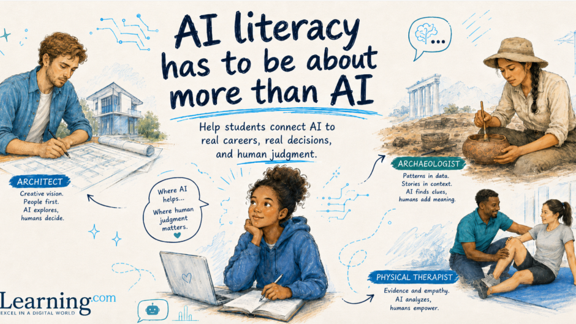
When students can connect a lesson on questioning AI outputs to the work of an architect, a physical therapist, or an archaeologist, the learning becomes less abstract. They begin to see that digital skills, critical thinking, creativity, and responsible decision-making are not separate from their future – they are part of it.
At Learning.com, we are pushing beyond a narrow definition of AI literacy as simply knowing what AI is or how to use a tool. We want students to understand AI in the context of the world they are growing into, so they can explore different careers, forge their own path, and be ready for the choices and responsibilities ahead of them.
That means helping students see how AI may show up in real work, what they need to understand, what it may change, and what human skills will still matter.
An architect may use AI to generate design options, but still needs human creativity, community context, and professional judgment to decide what makes a building meaningful.
An archaeologist may use AI to identify patterns, analyze images, or locate possible sites, but still needs cultural understanding, historical context, and ethical judgment to interpret what is found.
A physical therapist may use AI-supported tools to analyze movement data, but still needs hands-on expertise, empathy, observation, and human connection to understand what a patient is experiencing.
These are the kinds of connections students need to make. Not because every student needs to become an AI engineer, but because every student will need to understand how AI may shape the work they do, the choices they make, and the responsibility they carry.
Resistance is a signal, not a barrier
Resistance to AI is showing up everywhere, including in the way young people and adults talk about it. Some are curious and excited. Some are skeptical. And some flat-out refuse to use AI because they see it as morally or ethically harmful.
We should not dismiss that resistance.
For many people, the concern is not just discomfort with a new technology, it is a deeper concern about agency, creativity, ownership, identity, privacy, bias, environmental impact, misinformation, and whether AI will flatten or exploit what makes human work personal and meaningful.
Those questions belong inside AI literacy, not outside of it.
AI literacy should not mean teaching students to accept AI without question. It should mean helping them understand both the possibilities and the tradeoffs. Students need to know how AI can support learning, creativity, productivity, and career exploration. They also need to understand why people are concerned about energy use, privacy, bias, misinformation, creative ownership, and misuse.
If our response is simply, “AI is here, get used to it,” we miss the point.
What district leaders should be asking
For district leaders, the question is not whether AI literacy should be included, that conversation is already here. The better question is whether our definition of AI literacy is big enough for the world students are entering.
AI literacy cannot be treated as a one-time lesson, a compliance requirement, or a narrow technical add-on.
It must be part of a broader effort to prepare students for learning, work, citizenship, and life in a world where AI is increasingly present. The opportunity for districts is to move AI literacy from a tool conversation to a readiness conversation.
That means asking:
- Are students learning how AI works, but also when and why to use it?
- Are students learning how to question AI outputs, verify information, and recognize bias?
- Are students connecting AI concepts to careers and real-world decisions?
- Are students practicing responsible use in age-appropriate ways?
- Are students seeing where human judgment, creativity, empathy, ethics, and context still matter most?
- Are students learning to see themselves as decision-makers, not just users of technology?
AI literacy must prepare students to make thoughtful, responsible decisions in a world where AI will be part of nearly every career.
That means students need more than technical understanding. They need context, real-world application, career connections, and practice making decisions. They need to understand where AI is powerful, where it is risky, and where people remain essential.
At Learning.com, we are helping students explore not just what AI can do, but what they can do with their own judgment, creativity, and care.
The goal is not to prepare students to become passive users of AI-powered tools. The goal is to prepare them to be informed, capable, creative, and responsible decision-makers in an AI-powered world.
That is the kind of AI literacy worth building.
And it is the kind our students deserve.