
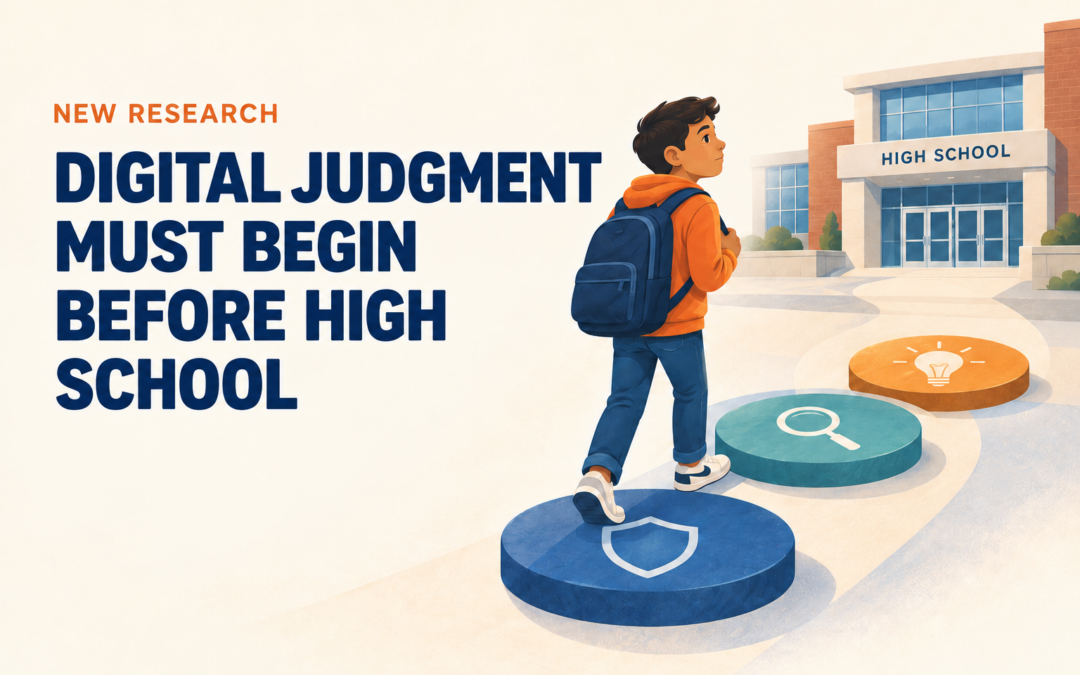
By the time students enter high school, many are expected to navigate school-issued devices, online platforms, and artificial intelligence tools with greater independence.
Recent research suggests that access and independence are expanding faster than students’ ability to use technology thoughtfully.
Students may know how to operate a device, open an application, or ask an AI tool a question. That does not necessarily mean they are prepared to assess what the technology produces, recognize when it is influencing them, protect their information, or decide whether using it will support—or replace—their thinking.
These are not skills students can suddenly acquire when they reach ninth grade.
The research points to a clear conclusion: Students need to begin developing digital judgment before high school. Through age-appropriate digital literacy, AI literacy, critical thinking, online safety, and digital citizenship instruction, students can learn to question what technology produces, protect their information, and recognize when a tool is supporting—or replacing—their thinking.
What is digital judgment?
Digital judgment is the ability to make informed, responsible decisions when using technology. It brings together digital literacy, AI literacy, critical thinking, digital citizenship, and online safety so students can evaluate information, understand how technology is influencing them, protect their privacy, and decide whether, when, and how a digital tool should be used.
Digital judgment must be developed progressively, beginning well before high school.
Why must digital judgment begin before high school?
A nationally representative survey conducted for the Thomas B. Fordham Institute asked 1,011 current high school students and 1,013 recent graduates about their experiences with school-issued devices, artificial intelligence, and other technology.
Sixty-two percent said they spent more than half of their class time using school-issued devices.
Many also reported using AI in ways that allowed them to bypass parts of the learning process:
- 36% used AI to summarize a book or another text to avoid reading it.
- 29% used AI to write the first draft of an essay or report.
- 26% used AI for help during a quiz or test.
The findings are specific to high school, but that is exactly why they matter for K–8 education.
By high school, students are often given more freedom to manage their assignments, conduct research, communicate online, and determine when and how to use digital tools. If students first encounter questions about responsible technology use at that point, schools are asking them to exercise judgment they have not had enough time or instruction to develop.
Rules and restrictions still matter, but they cannot substitute for a foundation.
Before access and independence expand, students need to:
- understand how digital and AI technologies work
- how those technologies collect and use information
- why digital content may be incomplete or misleading
- when a tool is helping them learn, or doing the intellectual work for them.
Is technology proficiency the same as digital readiness?
Another recent Gallup survey illustrates the gap between technological adaptation and critical thinking.
Only 20% of Americans said K–12 schools are doing a good or excellent job preparing students to think critically and solve problems. By comparison, 44% gave schools positive marks for preparing students to adapt to new technologies.
That difference matters.
Students are often quick to learn the visible mechanics of a new platform. They can figure out where to click, how to complete a task, or how to generate a response. But operational proficiency does not automatically produce digital readiness or judgment.
- A student can use a search engine without knowing how its results are ranked.
- A student can interact with an AI chatbot without understanding that its response may be inaccurate, biased, or fabricated.
- A student can share content without considering who created it, why it was created, or whom it could affect.
- A student can complete an assignment with technology without retaining the knowledge or developing the skill the assignment was intended to build.
Preparing students for a technology-rich future requires more than teaching them to adapt to the next tool. It requires teaching them how to think about technology, and how to think for themselves while using it.
Does more classroom technology lead to more learning?
The question is not whether technology belongs in education. Digital tools can increase access, support differentiated instruction, help students practice specific skills, and make learning possible in ways that would otherwise be difficult.
The more important question is whether technology is being used purposefully.
A separate Gallup study of 2,101 public school teachers found that 96% said their students use learning devices in class. Yet 61% believed students should spend less time on those devices.
Teachers did not reject technology outright. Fifty-two percent said learning devices do approximately equal amounts of harm and good, while 18% said they do more good than harm, and 29% said they do more harm than good.
The study also found an important connection between adult oversight and perceived effectiveness.
Only 42% of teachers said they had a great deal of oversight over what students were doing on devices during classroom instruction. Among teachers who reported having a great deal of oversight, 67% agreed that digital tools helped students learn more effectively. That figure fell to 49% among teachers with little or no oversight.
The findings suggest that the effectiveness of classroom technology depends not only on the device or application, but also on how it is introduced, managed, and connected to instruction.
This is why purposeful technology use is not the same thing as more screen time. Effective instruction may be teacher-led, student-led, or blended. It may involve a digital activity followed by group discussion, writing, hands-on practice, or an opportunity for students to explain their reasoning without the tool.
Technology should support the learning goal. It should not determine the learning experience.
How should schools evaluate educational technology?
The American Psychological Association’s report on children’s and adolescents’ learning with educational technology offers a useful standard for evaluating technology in education: Engagement is not the same as learning.
Time spent, activities completed, and student enjoyment can show that students are participating. Those measures do not necessarily demonstrate that students understand, remember, or can apply what they encountered.
The APA recommends evaluating educational technology according to what learners can do after they leave the tool:
- Can they explain the concept in their own words?
- Can they apply it to a different problem?
- Can they remember it later?
- Can they complete the work without built-in prompts or support?
The report also warns that AI may improve immediate performance while reducing independent learning. A student may produce a stronger-looking answer while developing less of the knowledge and skill needed to create that answer independently.
That distinction is especially important as generative AI becomes easier to access.
The goal should not simply be to help students complete work more efficiently. Technology should leave them more knowledgeable, more capable, and better prepared to make informed choices on their own.
What digital and AI skills do students need before high school?
Digital and AI readiness should develop through an age-appropriate progression, not begin with unrestricted access to student-facing AI tools.
Early elementary: Explore and build foundations
Young students can begin learning how to:
- Understand private from public information
- Protect private information
- Recognize when they should ask a trusted adult for help
- Understand that technology is created by people
- Distinguish between people and machines
- Pause before clicking, sharing, or responding
- Recognize that not everything they encounter on a screen is true
These concepts can be taught through teacher-led instruction, classroom conversation, stories, guided demonstrations, and offline activities. Young students do not need independent access to generative AI to begin developing AI literacy.
Upper elementary: Apply skills with growing independence
As students begin using technology more independently, they can learn how to:
- Evaluate websites and other sources of information
- Recognize advertising, persuasion, and manipulation
- Understand digital footprints and data privacy
- Communicate responsibly in digital spaces
- Recognize where algorithms and AI appear in their lives
- Question why they are seeing a particular result or recommendation
- Compare information across multiple sources
At this stage, instruction can help students move from following rules toward understanding the reasoning behind safe and responsible digital choices.
Middle school: Evaluate, create, and think critically
Before students enter high school, they should have opportunities to:
- Evaluate the credibility of digital information
- Question AI-generated responses
- Recognize bias, fabrication, and missing information
- Understand how platforms and AI systems collect and use data
- Consider who created digital content and for what purpose
- Recognize when technology is supporting, or replacing, their thinking
- Consider how their digital decisions may affect other people
- Explain why they decided to trust, reject, use, or share information
These skills should be practiced across subjects and situations. Digital judgment is not a single lesson, an annual safety presentation, or a list of rules attached to a device agreement. It develops through repeated instruction, reflection, discussion, and application across grade levels.
As students grow, they should become increasingly prepared to ask:
- What information is this tool collecting?
- Why am I seeing this particular result?
- Who created this content, and for what purpose?
- What evidence supports this answer?
- What perspectives or information might be missing?
- Could this image, video, or message have been altered or generated?
- Is the technology helping me think, or avoiding the need to think?
- Who could be affected by what I share or do next?
- Should I trust, share, use, or act on this information?
Students do not need direct access to an AI chatbot to begin learning what AI is, where it already appears in their lives, how it uses data, why its outputs can be wrong, and why human judgment remains essential.
That foundation should be in place before student-facing AI tools are introduced.
How can schools build digital judgment across K–12?
Schools cannot predict which platforms, devices, or AI systems today’s students will use as adults. They can help students develop the durable knowledge and habits needed to navigate whatever comes next.
That means treating digital and AI literacy as progressive components of a K–12 education, not as responses introduced only after distraction, misuse, or academic dishonesty has become visible.
A strong K–12 digital literacy curriculum can build that foundation progressively across grade levels. It should teach the durable concepts and judgment students need in any digital environment, not train them to use only one platform or place them in front of another tool.
Instruction can be teacher-led, student-led, or blended according to students’ ages, needs, and learning goals. Schools can combine direct instruction, guided discussion, collaborative activities, hands-on learning, offline practice, and purposeful use of digital lessons.
By the time students enter high school, they should already know how to protect their information, question what they encounter, recognize when technology is shaping their choices, and use digital and AI tools without surrendering the thinking that learning requires.
High school should deepen and apply that judgment.
It should not be the first place students are asked to develop it.
The tools will change.
The foundation should already be there.
Frequently asked questions
What is digital judgment for students?
Digital judgment is the ability to evaluate digital information and technology, protect personal information, recognize how technology influences choices, and decide whether, when, and how a digital tool should be used.
Why should digital and AI literacy begin before high school?
Students encounter digital systems and AI long before high school. Beginning instruction earlier allows them to develop safe, responsible habits and critical-thinking skills before they receive greater access to technology and greater independence in how they use it.
Does teaching AI literacy require students to use generative AI?
No. Students can learn what AI is, where it appears in their lives, how it uses data, why its outputs may be inaccurate or biased, and how to evaluate its influence without directly using a public generative AI tool.
Does digital literacy instruction require more screen time?
No. Digital literacy can be taught through teacher-led discussion, offline activities, collaborative work, guided demonstrations, student-led digital lessons, or a blended approach. The delivery method should reflect students’ ages, needs, and learning goals.
Read the research
- High Tech, Low Standards: High School in the Age of Distraction — Thomas B. Fordham Institute
- Satisfaction With K–12 Education Hits New Low — Gallup
- Screens Ubiquitous in Classrooms; Teachers Split on Efficacy — Gallup
- Children’s and Adolescents’ Learning With Educational Technology — American Psychological Association