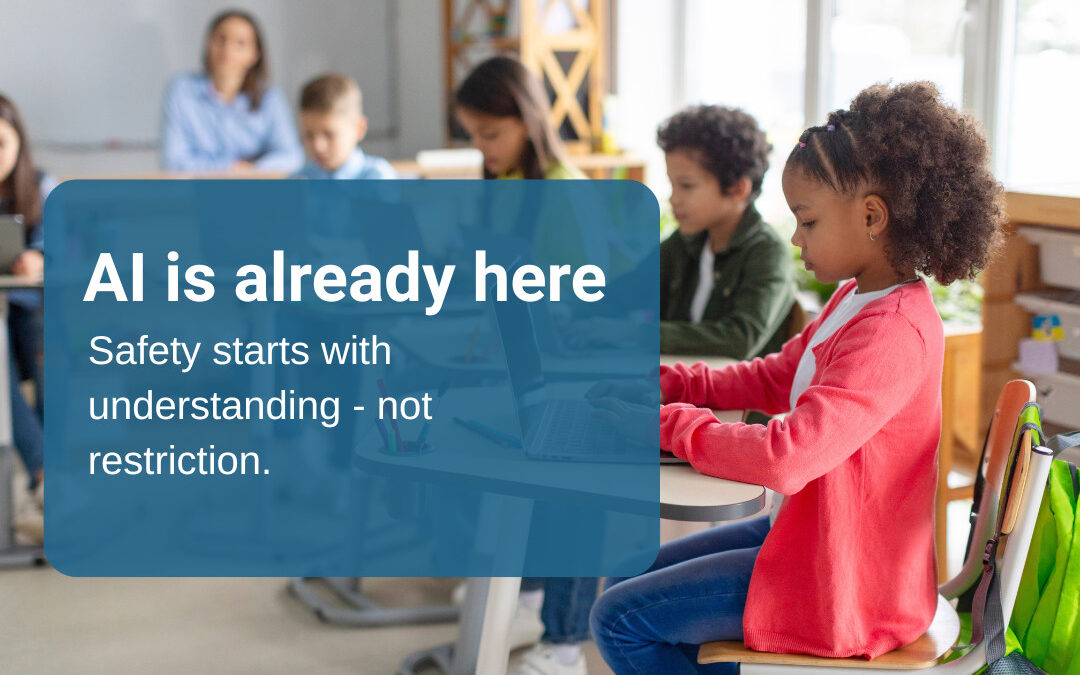
Students aren’t waiting to be taught AI – they’re already using it.
What they’re missing isn’t access. It’s guidance.
As districts move from "Should we allow AI?" to "How do we ensure teachers and students use AI responsibly?", one thing is clear: safety and guardrails must come first, especially in K–8. When we talk about guardrails, we mean both the technical boundaries schools set and the instructional foundation that helps students understand, question, and use AI responsibly within those boundaries.
Why this matters now
Research shows a clear gap between student behavior and school readiness:
- Students are already using AI independently – often without understanding how it works or how to evaluate outputs
- Teachers need more support to guide AI use, especially around bias, misinformation, and ethics
- District policies are still evolving as adoption accelerates
Sources:
UNESCO – Guidance for Generative AI in Education and Research (2023)
https://www.unesco.org/en/articles/guidance-generative-ai-education-and-research
OECD – AI and the Future of Skills (2023)
https://www.oecd.org/education/ai-and-the-future-of-skills.htm
Common Sense Media – Teens and AI Report (2024)
https://www.commonsensemedia.org/research/teens-and-ai
What safe AI learning requires
AI safety isn’t about limiting access. It’s about putting the right guidance in place.
- Technical guardrails – Controlled environments, no student data used for training, content filters, and teacher visibility
- Behavioral guardrails – Clear expectations for appropriate use, academic integrity, and real-world impact
- Pedagogical foundation – Students learning to understand, question, and evaluate AI can be the foundation upon which they build the judgment to use AI responsibly.
Research shows students often over-trust AI outputs – especially younger learners – making explicit instruction essential (Stanford HAI: https://hai.stanford.edu).
Start with understanding, not access
As AI tools become more available, schools are exploring how to introduce them.
The strongest guidance is consistent:
AI literacy is the foundation for safe and effective use.
When students understand how AI works – and where it falls short – they make better decisions.
Source:
European Commission – Ethical Guidelines on AI in Education
https://education.ec.europa.eu
Questions worth asking
- Are students using open tools or a controlled environment?
- Is student data protected and not used for model training?
- Are we teaching how AI works – not just how to use it?
- Do teachers have visibility and clear guidance?
- Can we explain our approach to families with confidence?
What this looks like in practice
Districts leading in this space are:
- Starting with structured AI literacy instruction
- Using safe, student-appropriate environments
- Embedding critical thinking and ethics into learning
- Supporting teachers with clear, built-in guidance
The bottom line
AI is already a part of the students’ world.
The question isn’t whether students will use it.
It’s whether they’ll use it safely, critically, and responsibly.
The districts that lead here won’t just protect students.
They’ll prepare them.
Learning.com is launching a free AI Literacy Quick Start Kit. It is a curation of lessons for K-2, 3-5, and 6-8 from our new EasyTech K-8 AI Literacy curriculum, available for the 2026-2027 school year. See safe AI Literacy in action and share it with your teams to review.