

Artificial Intelligence (AI) is rapidly reshaping education, offering powerful tools that promise to personalize learning, save teachers time, and prepare students for a tech-driven future. But for many K-12 educators, the sudden influx of AI platforms can feel more overwhelming than empowering, especially when implementation happens without support.
- To help administrators lead this shift with clarity and purpose, this blog covers:
- What “AI in K-12 education” means in today’s classrooms
- Best practices for rolling out AI and gaining buy-in
- Practical strategies for responsible, teacher-friendly integration
- Vetted AI resources for teachers and administrators
- Ways to scale AI use while keeping educators in control
Done right, AI can become a valuable partner in your district’s instructional toolkit. Let’s begin by clarifying what it actually looks like in a school setting today.
The Basics of AI in K-12 Education
Understanding the scope of AI’s impact is the first step to integrating it in ways that empower educators and support student success.
AI in K–12 education refers to technologies that mimic human cognitive tasks—such as learning, writing, analyzing data, or making predictions—and apply them to support classroom teaching and learning. In practice, this includes adaptive learning platforms, automated grading tools, generative AI like ChatGPT, and personalized student support systems.
What makes AI relevant now isn’t just the technology itself, but its accelerating presence in the classroom. In just the past two years, AI tools have moved from novelty to near ubiquity, often without clear guidelines or guardrails. For administrators, this rapid growth raises an urgent question: how do we equip teachers to use AI tools effectively without overwhelming them?
The Double-Edged Sword of AI Adoption in K-12
AI in K-12 education holds enormous promise. But the speed of its adoption has left many educators struggling to keep up. For teachers already stretched thin, the idea of learning and implementing new AI tools can feel more like an added burden than a benefit.
Challenge 1: Information Overload
New AI tools are appearing at a dizzying pace, and many educators don’t have the time or support to evaluate what’s worth using. The rollout of generative AI has created a whiplash of confusion for teachers who struggle to stay on top of an overwhelming volume of options.
Challenge 2: Need for Training
Schools and districts have been rapidly rolling out professional development related to AI in the classroom. About three-quarters of teachers were expected to have received training by the fall of 2025, up from less than 23% just two years earlier. This is critical, because without structured guidance, misconceptions take root: that AI will encourage cheating, widen equity gaps, or even replace teachers.
Challenge 3: Increased Workload
If poorly implemented, AI can actually add to teachers’ tasks by generating content they still have to review, or raising privacy questions they’re unequipped to answer. And while most states still lack formal AI policy, educators are left to guess at what’s safe, legal, or effective.
While the benefits of AI in K-12 in education are extensive, these risks pose a real challenge to educators. That’s where administrators need to step in to provide support, clarity, and structure that teachers need to succeed.
Best Practices for Integrating AI in K-12 Without Overwhelming Teachers
Don’t be dissuaded by the challenges. When implemented thoughtfully, AI can and will lighten the load for your teachers while enriching the lives of students. Below are some of the most effective strategies you can use to introduce AI in ways that feel manageable and productive, not disruptive.
Start with Teacher Pain Points and Early Wins
Before introducing a new tool, ask: Will this make a teacher’s day easier?
The best AI implementations begin with solutions to real classroom challenges. This article from Education Week has some great examples:
- Grading assistance: One high school teacher cut test creation time from 10 hours to just 40 minutes using AI to generate and format questions.
- Family communication: A fifth-grade teacher used ChatGPT to draft weekly newsletters, saving nearly an hour per week.
- Personalized feedback: An English teacher used AI to generate individualized essay feedback for each student, cutting the time spent per paper in half.
By focusing on tools that solve practical problems—like grading, content creation, or differentiation—administrators can build staff buy-in. Start small: pilot one or two high-impact tools with a single department, then scale based on feedback and results.
Provide Ongoing Training and Clear Guidelines
Educators won’t adopt what they don’t understand. That’s why continuous professional development throughout the school year is essential.
Effective AI training should include:
- A basic explanation of how AI works and what it can (and can’t) do
- Demonstrations of relevant tools tailored to grade level or subject area
- Ethics and privacy considerations, including FERPA compliance and data transparency
- Time for teachers to experiment and ask questions in low-pressure settings
In parallel, develop internal policies to answer common questions:
- What tools are approved for classroom use?
- How should students’ use of AI be monitored?
- What counts as responsible or inappropriate AI use?
Clarifying expectations and giving teachers time to explore is the main goal here. Done right, you can turn anxiety into curiosity and foster a culture of innovation rather than resistance.
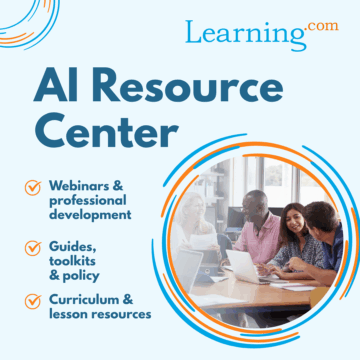 Learning.com developed an AI Resource Center to support administrators and teachers in understanding and leveraging AI in K-12 education. The AI Resource Center offers vetted resources from credible sources and experts, including:
- Webinars and professional development opportunities
- Guides, toolkits and policies
- Curriculum and lesson resources
All of which are designed to equip and empower educators in the age of AI.
Empower Teachers, Don’t Replace Them
Educators are looking for tools that respect their expertise and help them reclaim time for instruction, feedback, and connection. But no one is comfortable with the idea of being replaced. That’s why it’s essential to frame AI as a collaborator, not an evaluator.
A helpful analogy from the U.S. Department of Education compares AI to an electric bike, contrasted with a robot vacuum. In this model, the teacher is still steering, but the AI adds power to the pedal. Teachers remain in full control, using AI to handle repetitive tasks, generate ideas, or provide scaffolding while staying accountable for instruction and student progress.
By affirming the teacher’s central role, administrators can create a culture where AI is embraced as a trusted assistant instead of a job security threat.
Scaling AI Integration with Confidence and Clarity
Once a foundation of trust and support is in place, administrators can begin to scale AI use more broadly.
Start by piloting tools in a single grade level or department. Gather feedback, monitor outcomes, and adjust before expanding districtwide. Many schools are also experimenting with short-term “AI units” or after-school clubs before launching full courses, giving both students and teachers room to explore without pressure.
Just as important is aligning AI tools to your district’s existing curriculum goals or standards, such as ISTE Standards or state digital literacy frameworks. When educators understand how AI helps meet familiar objectives, they’re more likely to see it as a natural extension of their practice.
Finally, maintain transparency. Share what’s working, invite feedback, and highlight success stories. Teachers are more willing to embrace innovation when they feel informed, included, and supported every step of the way.
Empowering Schools to Use AI in K-12 Education the Right Way
When integrated with care, clarity, and a strong foundation of teacher support, AI has the potential to transform K-12 classrooms. By focusing on teacher needs, providing training and guidance, and aligning tools with learning goals, administrators can ensure that AI serves to strengthen the classroom experience without replacing the role of educators.
Regardless of how much or little AI your school is currently using, Learning.com has resources that can help ease the transition. Our EasyTech curriculum can help students build essential digital skills, including a foundational understanding of emerging technologies like AI. Request a free demo today.